Glendora's mature tree canopy is one of its most appealing features, especially in the older neighborhoods like the area around Big Tree Park, named for the historic Moreton Bay Fig planted in the 1880s, and the established streets of Glendora Village and the Citrus Park area. Those same beautiful old trees are also the leading cause of recurring sewer problems in these neighborhoods. Tree root intrusion into sewer laterals is one of the most common sewer calls we get, and it has a frustrating tendency to come back after each clearing unless the underlying issue is addressed.
This post explains why roots get into sewer laterals, why it is worse in Glendora's older tree-heavy neighborhoods, how to recognize the signs, and the trenchless fixes that can stop roots from returning without digging up your yard.
Why tree roots invade sewer laterals
A sewer lateral is the pipe that carries wastewater from your home out to the public sewer main. It is a steady source of exactly what tree roots seek: moisture and nutrients. Roots cannot sense water through a sealed pipe, but they can find their way to the tiny amount of vapor and moisture that escapes from joints and small cracks. Once a root finds a joint, it pushes a fine tendril through the gap, and inside the nutrient-rich pipe it grows rapidly into a dense root mass.
The pipe material matters enormously here. Older Glendora homes were built with clay sewer laterals, which are made in short sections joined with bell-and-spigot connections. Those joints, sealed originally but loosened over decades of soil movement, are the primary entry points for roots. Clay is the most root-vulnerable common sewer material, which is exactly why root intrusion concentrates in Glendora's older neighborhoods where clay laterals are the norm.
Why it's worse in Glendora's older neighborhoods
Two factors combine in neighborhoods like the Big Tree area, Glendora Village, and the Citrus Park area. First, these neighborhoods have Glendora's oldest and largest trees, including figs, oaks, jacarandas, and eucalyptus, species with extensive, aggressive root systems. The bigger and older the tree, the larger and more far-reaching its roots. Second, these same neighborhoods have the oldest sewer laterals, the clay pipe with the vulnerable joints. Mature aggressive trees plus aging clay laterals is the exact recipe for chronic root intrusion, which is why it is the defining sewer issue in this part of Glendora.
Signs of root intrusion in your sewer lateral
Recurring slow drains and backups
The hallmark sign is a sewer problem that keeps coming back. You get the line cleared, it works for a while, then the slow drains and backups return. That cycle is the signature of roots regrowing in the lateral.
Gurgling sounds from drains or toilets
Roots partially blocking the line trap air, producing gurgling noises as water passes the obstruction.
Multiple fixtures affected at once
Because the lateral serves the whole house, root intrusion in the lateral affects multiple drains, not just one fixture. If your lowest drains (often a downstairs toilet or shower) back up when you run water elsewhere, the shared lateral is restricted.
Sewage odors in the yard
In advanced cases, a root-damaged lateral can leak, producing sewage odors or unusually lush patches in the yard along the pipe's path.
The first step: a camera inspection
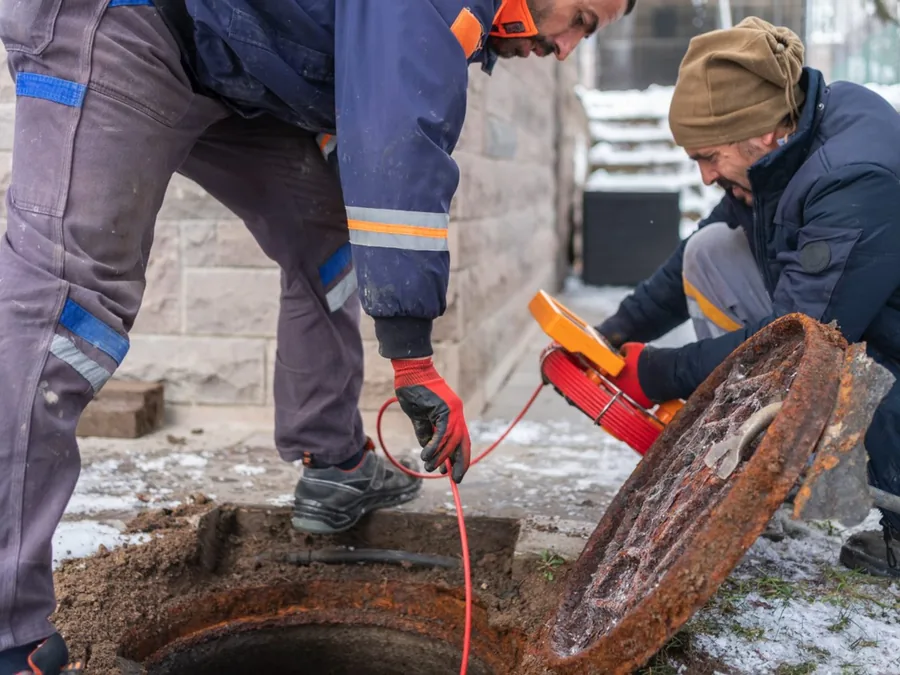
Before any meaningful fix, we run a sewer camera through the lateral. The camera shows exactly where the roots are entering, how severe the intrusion is, and critically, the structural condition of the clay pipe. That last point determines which fix is appropriate: a structurally sound pipe with root intrusion at the joints is a candidate for lining, while a pipe that has been cracked or crushed by root pressure may need replacement. The camera takes the guesswork out of the decision.
The fixes, from temporary to permanent
Hydro jetting (clears, but does not prevent)
Hydro jetting uses high-pressure water to cut through and flush out the root mass, restoring full flow far more thoroughly than a cable auger. It is the right immediate step to clear a blockage. On its own, though, jetting does not stop roots from coming back, since the entry joints remain open. In Glendora's aggressive-root neighborhoods, roots typically regrow within one to three years after jetting alone.
Trenchless cured-in-place pipe lining (the lasting fix)
For a clay lateral with sound walls but recurring root intrusion at the joints, trenchless lining is the solution that breaks the cycle. A resin-saturated liner is inserted into the existing pipe and cured in place, forming a new smooth, jointless pipe inside the old one. With no joints for roots to penetrate, the lining stops root re-entry for the structural life of the liner. Best of all, it is installed through existing access points without digging a trench across your yard, preserving the mature landscaping that makes these neighborhoods special.
Full sewer replacement (when the pipe is too far gone)
When the camera shows a clay lateral that roots have cracked, crushed, or collapsed past the point where a liner can be supported, full replacement with root-resistant SDR 35 PVC is the durable answer. The solvent-welded joints of modern PVC eliminate the gaps that let roots in, ending the problem permanently. We coordinate the City of Glendora and LA County Sanitation Districts permits for replacement work.
Stop the cycle of recurring root problems
If your Glendora home has a sewer problem that keeps coming back, root intrusion in the lateral is the likely cause, and clearing it again without addressing the joints just resets the clock. We camera-inspect, clear the roots, and provide trenchless lining or replacement options that actually stop the recurrence. Learn more on our sewer line repair page or our Big Tree area page.